
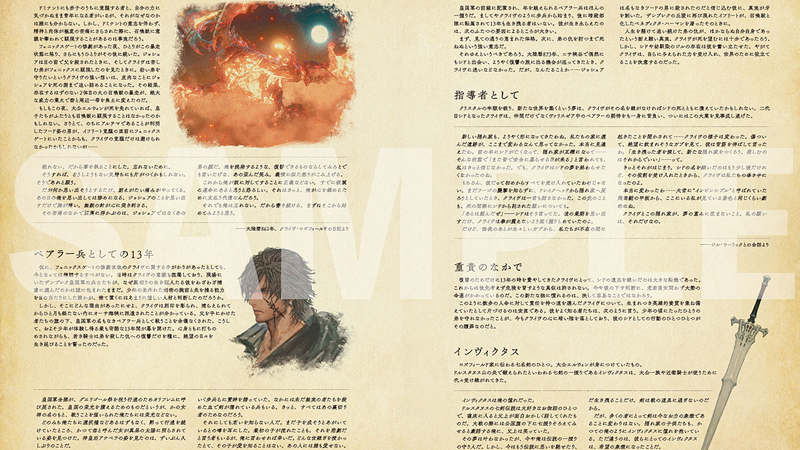
Here is the full text of the sample pages (p. 44-47) from the Japanese edition of LOGOS. Naturally, the ST is copyrighted by SQUARE ENIX and all text is subject to revision. I’ve refined my translations a bit, having mulled them over for a few days, but nothing major has been changed from the excerpts I shared on Xitter. As usual, I’ve included notes on the translation below for anyone who might be curious to take a peek behind the curtain, so to speak.
The body of the text is composed as though it were written by the hideaway’s resident historian, Harpocrates, with journal entries and interviews with other characters inserted to offer insight into different perspectives. I’ve made an attempt to carry those voices through, keeping in mind that people often write in a different tone/register than they tend to speak in, but it could probably still use some massaging. Since this translation isn’t going to print, though, I’ve decided not to worry about it.
The Japanese edition of LOGOS is due to be published on 26 December 2025, while the English edition is due out 31 March 2026. I expect I’ll be posting other excerpts in the interim for those interested, but I’m curious as to whether the content will be the same across language editions or differ slightly. Both Maehiro and Koji Fox are credited as authors, of course, along with certain members of the English voice cast (Ben Starr, Stewart Clarke, Christopher York, etc.) but since there are slight differences in characterisation between language versions, especially in the case of Clive, I’m wondering if those contributions will be translated as-is, or if some of the Japanese voice cast might also contribute. There are also some differences in worldbuilding/lore. It’s possible they might use this as an opportunity to try and reconcile the two, but we’ll just have to wait and see. I’ve preordered both versions, so if I spot any interesting differences, I may share those as well :)
※ If you don’t want to see LOGOS content prior to the release of the English edition, feel free to mute the hashtag #FF16L on Xitter.
※Contains spoilers
P.44
THE DOMINANTS
Ifrit’s Awakening
There are those who awaken as Dominants in infancy, and those who reach adolescence without realising their own power, though none can say quite why this is. However, it is likely fact that—independent of their own will—when a Dominant is subjected to extreme mental and physical torment, the Eikon may on occasion take over and run rampant.
On the Night of Flames, one descended into this state of uncontrollable frenzy, and the other followed in his wake. Joshua, when he saw his father slain before his very eyes, and Clive, upon seeing that his anguished brother had primed into the Phoenix. Clive’s strong desire to protect his younger brother ironically drove Joshua to the brink of death. As a result, the rampage of a second Eikon of Fire—something that ought not to have existed—turned the fortress and surrounding terrain to scorched earth in the inferno of his devastating flames.
If, perchance, Archduke Elwin had evaded death that night, perhaps neither of his sons would have primed into Eikons. And yet, the presence of the hooded man—later determined to be Ultima—at Phoenix Gate directly preceding Ifrit’s manifestation suggests that Clive’s awakening, at least, might have been unavoidable...
I can’t sleep. So I’ve taken to penning my thoughts. So as not to forget.
If I do that, I might be able to bring some closure to these impossible emotions. Would that it be so.
But each time I try to recall something, I’m assaulted by nigh unbearable pain. Whenever I think back to myself on that day, I become wretched. Just remembering Joshua makes my chest ache. Countless needles pierce my heart.
In the midst of that agony, what surfaces in my mind is not Joshua but that man’s face. That warped smile that seemed to taunt me, as though to say, If you think you can take your revenge, try it, why don’t you? A rage akin to righteous fury comes boiling up.
From this point onward, nothing I do to that cur will have any part of justice. To think I’m already destined for ruin chills me. That is, doubtless, the price I will pay in exchange for assuaging my heart.
Even so, I will not forget. So I continue to write. I think I shall begin from there.ーExcerpt from the journal of Clive Rosfield, Year of the Realm 861
13 Years as a Branded Soldier
Even had clues concerning Clive existed in the immediate aftermath of the Night of Flames, there is no longer any means of confirming them. At the time, Clive’s consciousness had been muddled, and the reason as to why the imperial soldiers present at the scene should deliberately take him—a living witness to their treachery—as a prisoner of war remains shrouded in mystery. Perhaps someone who had seen firsthand the boy’s exceptional skill with a blade and ability to manipulate flame determined he was far too valuable an asset to dispose of.
However, whatever the reason might have been, what we do know is that Clive was branded and deployed to the Strait of Autha less than a month after his capture. Under the banner of those who had slain his father, he was forced to fight as a nameless Branded in the imperial army. And thus, did the curtain rise on what were to be thirteen of the cruelest years a young man could possibly experience. Though broken in body and spirit, the young knight vowed to survive the days of despair, sustained solely by his desire for vengeance against the foe who slew his younger brother.
The imperial army was recalled to Oriflamme for the sake of the procession celebrating the Feast of Greagor. Allegedly it’s to extol the glory of the empire, but to we who are forced to fight in that goddess’s name, no such thing exists.
Not that we’d a choice in the matter, in any case. As I continued mutely processing, I caught sight of the woman I once called mother, illumed by the midday sun. It had been quite some time since I’d seen the Holy Empress Anabella.
She waved her hand from a balcony of marble, acknowledging the soldiers passing before me. Amongst them are those whose swords are still wet with the blood of innocents. All for the sake of that traitoress, no doubt.
But truly, the years haven’t touched her. I’ve heard rumor she still endeavors to have a child. And that she miscarried her first. There are those who would call that a tragedy, but I’d say it’s fortunate. Whatever sort of heir she bore, the child would know no love. That woman is incapable of loving anyone.
Tomorrow, we head east.ーExcerpt from the journal of Clive Rosfield, Year of the Realm 865
P.45
THE DOMINANTS
Beyond the Truth
Only a handful of those stationed on the imperial army’s front lines live to see the following year. Much less those like Clive, who began as an infantryman before being transferred to the assassin corps; of these, none survive for thirteen long years. His continued survival is thanks in large part to the two following factors:
First, as is plain to see, that he was blessed with a powerful frame. And second, his unyielding determination not to perish before avenging his brother’s death.
Thus, it may be said that, upon his chance meeting with Cid in the Nysa Defile in Y.R. 873, with the chance to embark upon his quest for vengeance finally at hand, Clive did not hesitate. Yet, alas...in the face of his abiding belief that Joshua was murdered by that nameless, hooded man, the truth bared its fangs. When the Eikon Ifrit appeared once more in the hills of Sanbreque and struck down Benedikta Harman, who had primed into her Eikon.
[Thus, was he forced to confront] the unbearable truth that his brother’s killer—the man he had staked his life in pursuit of—was none other than he himself. It was, surely, more than sufficient cause for Clive to wish for death. However, the presence of Cid and his childhood companion Jill lit a fire within him. In time, Clive came to accept the power bestowed upon him and resolved to use it for the sake of the world.
As a Leader
The dream of shattering the crystals’ prison and building a new world might have died with Cid had Clive not inherited his name. Having become Cid the Second, Clive took upon himself the hopes and expectations of not only his comrades, but also those of Bearers across all of Valisthea—and in the end, accomplished this monumental task admirably.
The new hideaway has finally started to take shape. I hadn’t imagined the ruins we chose for our new home would change this much. Truly, I hardly recognise them. When Cid passed away last year, and the hideaway was reduced to rubble...if, at that point, I’d been told, “The day will come when we can all live in safety again,” I doubt I’d have believed it. But Clive didn’t want to let Cid’s dream end.
Of course, not even he thought to take all this on from the beginning. When we were making our way back to the hideaway from Drake’s Head, ignorant of Hugo’s attack, Clive didn’t say a word about it. Not about what lay ahead, nor about the wish Cid had entrusted him with on the brink of death.
“The rest is in your hands”—that’s what Cid had said. Every time he recalled Cid’s final moments, Clive would clench his hands tightly into fists to keep them from shaking.
But when Gav, wounds still raw, told us what had transpired in our absence...Clive’s demeanor changed. Looking at Gav, hurt and on the verge of being consumed by despair, Clive stood taller and said, “Let’s find those who survived, and build a new hideaway. Mourning can come after that.” ...
That was the beginning, surely. It was a little after then that he assumed Cid’s name, but from the moment he took up that role, Clive became the one to guide us.
He really has changed...about as dramatically as the scenery I’m viewing as I stand here on the deck of this flying ship known as the Invincible in ages past.
That Clive and this hideaway don’t sink under the weight of that dream. That’s all I wish.ーFrom a conversation with Jill Warrick
Amidst Grave Responsibility
For Clive, who had poured thirteen years solely into vengeance, taking up Cid’s cause was a pivotal moment. From that point onward, recklessness with no thought to consequence would not be permitted him. Not now that the fate of so many—old and young, men and women alike—rested upon the decisions he would make. Surely, acclimating to this new set of shackles was by no means an easy task.
To say that Clive, who had chosen the path of bearing responsibility for the lives of countless others, had done so due to some innate quality of heroism would be an oversimplification. Those who know him well would say the following: That being unable to protect his one and only younger brother as a boy still casts a dark shadow upon Clive’s heart, and that his every deed as Cid is a form of atonement for it.
Invictus
One of seven blades passed down in House Rosfield. The sword Archduke Elwin carried on his person.
Invictus, said to be one of seven legendary blades forged in the fires of Mt. Drustanus, has been passed down through the generations for use by the Archduke’s family and his closest Shields.
I had admired Invictus.
The legend of the Seven Blades of Drustanus was amongst my favorite boyhood tales, and when I went to bed, Father would regale me with stories of it. When I said I’d assemble all seven blades under the ducal standard in the event of a large scale war, Father laughed at my boasting.
That dream never came to pass, but I am now the keeper of one legendary blade. However, I no longer give more than a passing thought to legends, nor do I think to locate the remaining six. The only thing on my mind is surviving. Since swords are nothing more than tools of war.
Yet, to many, swords remain—as ever—a symbol of power. The children at the hideaway, too, harbor admiration for Invictus, as I once did. The sole difference is that, to them, Invictus has become a symbol of hope.ーExcerpt from the journal of Clive Rosfield, Year of the Realm 878
P.46
THE DOMINANTS
Ifrit
The faiths extant in Valisthea are myriad and many, but the one point on which they all agree is that, when the world was made, eight Eikons were born of the eight elements. For this reason, rumors that a ninth Eikon had appeared at Phoenix Gate were long dismissed. However, when the Eikon reappeared thirteen years later, news of the existence a second Eikon of Fire known as Ifrit began to spread throughout the realm.
As a Vessel
Dominants and their Eikons, long regarded as the guardians of nations, have heretofore been thought of as those chosen by the gods, who wield their respective elements on behalf of the people. However, in encountering the being known as Ultima, Clive came to learn of a “divine plan” drawn from an entirely different perspective.
If one is to believe Ultima’s tale, the Eikons are no more than entities created so as to be sacrificed to Ifrit—which is to say, Clive. It is said that once he becomes a vessel complete, a god capable of wielding all elemental powers at will shall assume possession of his body.
Ifrit first manifested in Y.R. 860, however, according to a survey conducted by the Undying, the Circle of Malius had prophesied Ifrit’s advent centuries before, and were even cognizant of the form he would take upon his coming. Though how they came to know such things remains a mystery, when Clive confronted Ultima at Drake’s Spine, he espied an ancient corpse greatly resembling Ifrit. He claimed it felt as though it had existed in this world long before the other Eikons—and by extension, humanity itself.
Abilities
Given that his very existence has been confirmed only recently, that he has manifested so infrequently, and that there are precious few surviving witnesses, little is known about Ifrit and his abilities. However, if anyone can credibly attest to this Eikon’s strengths and weaknesses, it would be Clive.
Like the Phoenix, Ifrit is an Eikon possessed of the ability to manipulate flames at will, however the nature of that flame is more given to destruction. While the Phoenix’s power truly shines in ranged attacks, it is clear from his battles to date that Ifrit—with his strength and speed, as well as his resilient physical form—excels in close combat. Something every Eikon to meet him in battle has surely learnt all too well.
Even should one manage to evade Ifrit’s fists, they next are met with his claws or the flames spewed from his maw. And even should one remarkably withstand these, what awaits him is a ball of flame so massive it could raze an entire fortress. As for Ifrit’s weakness, according to Clive it would be...the fact that he cannot fly.
Ifrit Risen
While possessed of outstanding agility and the ability to leap immense distances, Ifrit lacks the ability to fly. A rather inexplicable shortcoming for the vessel Ultima has chosen for his supreme triumph. In fact, “shortcoming” is rather understating it, when one considers the fact that it clearly puts Ifrit at a disadvantage against all of the Eikons meant to serve him, save one. Surely, it would have been more advantageous for Ifrit to have wings as well, so as to contend with his sacrifices. There is no contesting that.
Indeed, this can be seen even in Ultima’s grand design. The Circle of Malius’ ancient mural depicts a winged Ifrit looking down upon seven of the eight Eikons attested to in the sacred texts passed down from antiquity. Based upon the fact that the Phoenix’s form is missing, even one who lacks Joshua’s depth of knowledge can easily deduce that the two Eikons of Fire were originally one. And, though it was but temporarily, the two Eikons did indeed become one when Bahamut attempted to raze Twinside. In that moment, the world bore witness to Ifrit’s true form, “Ifrit Risen.”
P.47
THE DOMINANTS
Joshua Rosfield
“We aren’t people. But we wish to be.”
ENG: [We are Dominants.] That is our fate. But that doesn’t mean we have to accept it.
Joshua Rosfield was born the second son of Rosaria’s Archduke in Y.R. 850 and, upon awakening as the Phoenix’s Dominant, was granted the right of succession to the Archduchy. Due to the vagaries of fate, he never did rule, but would later ascend to the office of Suzerain of the Undying and—with the aid of his faithful acolytes—operated in the shadows to bring Ultima’s machinations to light.
Childhood
In Valisthea, all newborn infants are required to undergo a test to determine whether or not they are Bearers. Just days after being born, Joshua—like his grandfather Elian before him—manifested the firebird’s flames.
One difference, however, being that he was sickly. While Elian had been a spirited child who flaunted his “gifts” before those around him, the court physicians prevailed upon Joshua, who was delicate of constitution, to rest so as not to endanger his health. In light of these circumstances, he grew to idolise the strength of those such as his father, brother, and the duchy’s stalwart Shields—and at times, even to envy them. Eager to watch them train, he often snuck out of the castle and incurred his mother’s displeasure.
Why is it, I wonder, that despite being proficient at everything and having a wealth of both knowledge and insight, Joshua can be so careless?
I remember the day an outdoor banquet was held for his nameday. Though various lavish events had been prepared, Joshua’s sole wish was to play in a nearby stream. The event was made a private affair at Father’s behest, with only a few guards in attendance, so I offered to take Joshua with me. Mother opposed the idea, claiming it was too dangerous, but I pretended not to have heard her. It was an overreaction for something so innocuous.
While Uncle Byron was entertaining the guests with an anecdote about wine, we made for the riverbank, taking care not to attract attention. When we reached the river, Joshua immediately stripped off his shoes and hose and began playing happily in the water.
To this day, I still remember that smile. Free from the gaze of watchful eyes, forgetting a life largely spent confined to quarters, he smiled happily. From the bottom of his heart, he enjoyed that brief moment of freedom. And in the next moment...he fell over.
Even then, the odd way in which he fell proved fortunate; his foot tangled in a riverside plant, allowing me to pull him from the water immediately. However Joshua, his entire body drenched through, had been shaken, and it was no longer the time for such amusements.
What ensued when we returned from the river is as apparent as a flame in the night, no doubt. The brunt of mother’s ire was directed at me. Saying that it was all my fault. The following year, Joshua did the same thing—although that time it was the Lord Commander who was, unhappily, singled out for punishment.It seems, even at this age, Joshua has yet to learn how to swim. And so, whenever he’s loitering about the pier I find I’m constantly on edge. Seeing as Obolus doesn’t strike me as the sort who’d go out of his way to jump in and save someone.
ーExcerpt from the journal of Clive Rosfield, Year of the Realm 878
Princely Stay
Should the prince’s breeches fall, it could impact the nation’s dignity—the craftsman charged with making Prince Joshua’s belt was given these words. While comely in appearance, it falls far short of the protection offered by iron tassets, and should it be struck with a spiked mace, naught would remain.
Life of Convalescence
When imperial soldiers infiltrated Phoenix Gate and beheaded his father before his very eyes, Joshua was only ten years old. Precious few lived through the chaos that followed and, had Joshua been the Dominant of any other Eikon, he himself would likely have lost his life at the hands of a rampaging Ifrit. The Phoenix possesses powerful healing abilities. Even so, had the Undying not been gathered beneath the fortress for the rite set to take place the following morn, it is safe to say that he would not have survived. For without them, there is no conceivable way a young child, gravely injured, could have evacuated the rubble and reached safety.
Over the next five years, in tandem with the Phoenix, the Undying labored devotedly to restore Joshua in both body and spirit. By and by, he regained consciousness at the age of fifteen and—resolved to divine the truth of that fateful night—embarked upon an adventure.
Notes:
Ifrit’s Awakening
- “On the Night of Flames, one descended into this state of uncontrollable frenzy, and the other followed in his wake” → In this sentence, the words “one” and “the other” are both ひとり (hitori) in Japanese. Often, this would be written with the kanji 一人 (one person/human being), but since Dominants are not strictly human—or not only human, at least—they’ve written the word in hiragana so as to avoid the connotation of “human.”
- “Clive’s strong desire to protect his younger brother” → literally, what it says is 幼い弟 (osanai otouto), which would become “young younger brother” or “young little brother” in English, neither of which sounds terribly natural. Moreover, there’s added nuance to the word 幼い (osanai) not strictly present in the English “younger.” It refers not only to being young in years, but also carries the added emotional weight that this is someone who should be protected. It encapsulates:
- weakness/frailty → someone that makes one want to protect them; unable to be self-sufficient, they require another’s care and protection
- innocence/purity → someone ignorant of the world, who has not yet been sullied by it
- immaturity/lack of polish → someone still developing in mind/spirit whose comprehension and discernment are not yet fully matured
- sweetness/adorability → small in that way that is unique to children, and often cute and dear because of it
- The words “strong desire” in the above phrase are more literally “strong emotions” (強い想い).
Y.R. 861 Journal Entry
- “I’ve taken to penning my thoughts” → The phrase here, 筆を執る (fude wo toru), literally means “to take up a brush.” I’ve added “my thoughts” to make it sound more like natural English. An alternate translation might be “I’ve taken to putting pen to paper”—or, in this case, quill.
- “I might be able to bring some closure to these impossible emotions” → The phrase I have as “impossible emotions” is literally どうしようもない気持ち (doushiyou mo nai kimochi) or “feelings about which nothing can be done.” “Bring some closure to” is 片がつく(kata ga tsuku) or “to settle/sort out/put an end to (a problem).” Though I doubt Clive could ever truly find ‘closure’ around the events of that night, perhaps he needed to believe that he could.
- “Would that it be so.” → literally, “I wish that it be so” (そうであれと願う), which doesn’t quite read naturally in English. Normally I would have gone with “I pray that it be so,” but because Rosaria has no official state religion, I opted for this phrasing instead.
- “From this point onward, nothing I do to that cur will have any part of justice.” → more literally, “From now on, as well, nothing I do to that fellow (奴) will have anything like justice in it.”
- The word 奴 (yatsu) has a wide range of meanings depending upon the speaker, who they are referring to, and the relationship between the two. Between friends or in reference to some unspecified person, it could mean something as benign as “that fellow/chap/bloke/guy” but more often it’s more derogatory, along the lines of “that blighter.” Historically, it meant a servant, especially a samurai’s attendant, and nowadays it can be neutrally used to refer to inanimate objects, even (though the kanji is often dropped in that case). However, given the wrath Clive feels towards the hooded man, I thought something a little stronger than “fellow” was called for. I considered blackguard—a thoroughly dishonorable or unprincipled person; a scoundrel, villain, or rogue. It was originally used to refer to the lowest-ranked servants in a noble or royal household, so there’s a parallel there—but there were much stronger words Clive might have used in Japanese if I were to opt for that term. “Cur” is of about the same register and has the same brief punchiness, so I went with that.
- “To think I’m already destined for ruin chills me.” → The phrase here is 破滅の運命にある (hametsu no unmei in aru), lit. “in a fate/destiny of destruction/ruin.” Other ways I considered translating this sentence include, “Thinking that I’m already set on the path to destruction terrifies me” and “It chills me to realize my fate is already sealed.” The implication is that Clive is aware this quest for vengeance will destroy him in body and spirit, but he’s willing to destroy himself to see it through, anyway—even as the prospect terrifies him. ㅠㅠ
- “assuaging my heart” → The phrase here is 心を鎮める (kokoro wo shizumeru), meaning “to quiet one’s heart/mind,” but in the sense of “to calm/quell/appease/lay to rest.” This is the same verb used to refer to appeasing wrathful gods or pacifying restless spirits. Other possible translations include, “Maybe that’s the price I have to pay to calm my mind” or “That must be the price I’ll pay to quiet my soul.”
13 Years as a Branded Soldier
- “Clive was branded and deployed to the Strait of Autha less than a month after his capture” → I said on Xitter that he would have been fighting against Veldermarke, but I misspoke. According to the Ultimania World Chronology, conflict over the straight broke out between Veldermarke and Sanbreque in Y.R. 842, and continued even after Barnabas conquered Veldermarke and founded Waloed the following year. So Veldermarke would have already been Waloed by Y.R. 860. My apologies! m(_ _)m
- “thirteen of the cruelest years a young man could possibly experience” → The Japanese here just says 少年 (shounen) eliding the article (e.g. “a” or “the”), so this could also be “the young man,” referring to Clive specifically.
Y.R. 865 Journal Entry
- “the Feast of Greagor” → This is me taking a bit of creative licence, since what it literally says is グエリゴール祭 (guerigooru-sai), i.e. “Greagor Festival” or “Festival of Greagor.” Seeing as certain elements of the faith resemble the catholic tradition, I played around with the idea of feast days.
- “Allegedly it’s to extol the glory of the empire, but to we who are forced to fight in that goddess’s name, no such thing exists.” → more literally, “for we who are forced to fight in that goddess’s name, there is no such thing as glory.”
- I have the word 裏切り者 (uragirimono), i.e. “traitor,” as “traitoress,” since this is the word Dion uses to refer to her in CH36, but in Japanese the word is actually ungendered.
- “the years haven’t touched her” → literally this is, “she’s someone who knows no aging” (老いを知らない人). It tickles me that they hung a lantern on the fact that her model doesn’t seem to have aged at all, even though 18 years have passed. Then again, she’s not the only character whose appearance doesn’t align with their given age.
- “she still endeavors to have a child” → The verb here is 足掻く (agaku), which more literally means “to struggle (at an endeavor).”
- “That woman is incapable of loving anyone.” → In Japanese, this is “That person is incapable of loving anyone.” I saw someone comment on this phrasing in Japanese, pointing out how referring to Anabella not as “mother,” or even as a “woman,” but just as “some person,” really illustrates how emotionally distant Clive feels from her, to not see her as either of those things. In a sense, this is the most impersonal and objective way he could refer to her in Japanese—it’s not actively rude or hateful; there’s little emotion in it at all. I thought this was right on the mark, but to my sense, calling her “that person” in English humanizes her in a way, by highlighting her personhood, whereas “that woman” captures the same air of emotional remove and dismissiveness.
- “Tomorrow, we head east.” → According to the Ultimania World Chronology, in Y.R. 865 Sanbreque retook the Strait of Autha, which they’d been warring with Veldermarke and then later Waloed over for some 23 years at that point. Since the strait lies to the east of Oriflamme, I think it’s reasonable to infer that Clive was part of the force that retook it.
Beyond the Truth
- This section is titled 真実の先に (shinjitsu no saki ni), which could alternately be translated as “On the Far Side of Truth” or “[What Lies] Ahead of Truth.”
- “of those, none survive for thirteen long years” → It’s occurred to me before that—beyond even his physique, fighting prowess, and single-minded pursuit of vengeance—Clive’s constitution as Mythos is a key factor in why he survived for so long as a Branded soldier. I doubt many other Bearers could have fought for so many years without succumbing to the curse, or else being so weakened by it that their ability to fight was fatally compromised. I do find it hard to credit that Clive could have been ignorant of the crystals’ curse all those years given his circumstances, though. That one doesn’t quite add up for me.
- “assassin corps” was my very direct translation of 暗殺部隊 (ansatsu butai), i.e. “assassination squad.” I was tempted to play around with something more in line with Koji Fox’s creative flare—call it the “Silent Order” or the “Order of the Ebon Wyrm” (after the eitrfoetida in their brands and respective codenames) or something similarly whimsical—but that seemed like taking a bit too much licence in an unofficial translation. Though “assassin corps” doesn’t quite sound medieval to me.
- I hadn’t thought to mention this, but since it came up on Xitter: “First, as is plain to see, that he was blessed with a powerful frame,” when translated verbatim is, “First, just as [one can] see, [a] blessed frame.” I reworded it so that it would read more naturally in English.
- “his unyielding determination not to perish before avenging his brother’s death” → The phrase I have as “unyielding determination” is literally 強い意志 (tsuyoi ishi) or “strong will.” Even more than the English, which tends to highlight the importance of having something greater than oneself and the nature of fate, the Japanese tends to place a focus on individual will and the power of the self. In a way, the Japanese is casting a light on the positive side of Western ideals of individualism, while the English is doing the same for Eastern ideals of collectivism. Both have their virtues—and their vices when taken to the wrong extremes.
- An example of this is when Joshua insists Clive would have been a more suitable Dominant for the Phoenix in CH06:
- (E) Joshua: It should have been you. I don’t have what it takes to lead our people. I don’t have the strength.
- (J) Joshua: This power is truly befitting of you, brother. The one who ought to stand as respresentative of his country is someone with a strong will.
- Or Cid’s response when Benedikta asks how Clive could have beaten her in CH12:
- (E) Cid: The answer is simple, Benedikta. He was fighting for something he believed in.
- (J) Cid: Suppose you might not understand. Those who’ve a strong sense of self are strong.
- lit. 自分を持ってる奴 = ‘those who have/are in possession of themselves.’ You could also translate this as ‘those who know who they are are strong.’
- Or Cid’s conversation with Clive at the top of CH18:
- (E) Cid: You’re not a monster. You’re the same man you’ve always been. Accept that, and you may yet escape your fate.
- (J) Cid: Don’t reject who you were in the past. Accept it. Accept Yourself.
- lit. 過去のお前をなかったことにするなよ = ‘don’t act as though the you of the past never was/don’t make your past self into nothing.’
- Or the famous ‘Press L3 + R3’ command in CH19. In English, of course, this is ‘Accept the Truth,’ but in Japanese it’s ‘Accept Oneself’ (自分を受け入れて).
- There are more and possibly better examples, but you get the gist.
- An example of this is when Joshua insists Clive would have been a more suitable Dominant for the Phoenix in CH06:
- “struck down Benedikta” → The verb used here is 屠る (hofuru), literally meaning “to butcher or slaughter” (as one would an animal) but used euphemistically to mean “to vanquish, overpower, massacre, defeat utterly.” Sounds about right. One of the dev interviews in Ultimania mentions that they had to scrap the first pass at this scene because it was too violent.
- [Thus, was he forced to confront] is in brackets because Japanese is a lot more forgiving of what, in English, would be considered incomplete sentences. These words are left to be extrapolated and are not expressly written here.
- “the man he had staked his life in pursuit of” → the Japanese phrasing here is interesting. There are multiple ways to say “life” in Japanese, and they all have their own uses and nuances. On my first pass of this translation, I had this as “risked his life” but I changed it since that phrasing lost some of the original nuance. Strictly speaking, “risk one’s life” would be 命懸けで (inochi-gake de) or sometimes 命を懸けて (inochi wo kakete) where 命 is “life” in the fundamental sense, i.e. the state of being alive or the biological existence of a living being. It’s closely tied to the concept of survival and death, and thus frequently used to describe life-threatening situations or risk of death, as in the above phrases. Here, however, the phrase used is 人生を懸けて (jinsei wo kakete), where 人生 is “life” in the sense of “the entire course of a person’s life from birth to death.” It encompasses experiences, choices, growth, and the passage of time, i.e. it’s not just existence but how one lives one’s life. The difference of nuance in this case is that former stresses that one is prepared to die or risk death, while the latter implies that one is risking all of one’s continued existence—one’s future and/or fate, say. Clive isn’t particularly attached to his life, but he can’t risk dying before exacting his revenge. In a sense, what’s he’s risking is the life he’s dedicated solely to his chance at vengeance, and therefore his shot at vengeance itself. Alternately, you could say that he’s dedicated his entire life to the endeavor, not necessarily with the risk of death (thought there certainly is that), but with the commitment of his whole being.
- “the presence of Cid and his childhood companion Jill lit a fire within him” → the verb used here is 奮い立たせる (furuitataseru), i.e. “to rouse, motivate, shake up, fire up, encourage, inspire.” I was originally tempted to use the word “galvanise” —and I would have, had they been speaking only of Cid, since galvanism is literally the therapeutic application of electricity to the body (hehe). But since they were speaking of both Cid and Jill’s roll in rousing Clive and getting him back on his feet, I opted for the fire idiom instead. (No one can accuse me of not being a word nerd.)
As a Leader
- “Clive took upon himself the hopes and expectations of not only his comrades” → There were two parts to this phrase I debated how to translate:
- “hopes an expectations”→ I used this pair of words together to translate the single word 期待 (kitai), which encompasses both.
- “took upon himself” → the phrase here is 一身に背負う (ichimi ni seou), meaning “to shoulder upon one body/person.” The implication being that all of those expectations, hopes, and lives rest upon Clive’s shoulders alone; that he’s chosen to take up that burden.
- “accomplished this monumental task admirably” → The word I have as “admirably” (見事) is sometimes awkward to work into English phrasing and dropped because of it. 見事 (migoto) or 見事に (migoto ni) means “brilliantly, splendidly, superbly, marvelously, masterfully, admirably, etc.” I thought that, of these, “admirably” fit most closely with Harpocrates’ voice, though to my sense, “brilliantly” would be closest in sentiment.
Y.R. 874 Conversation with Jill
- “if, at that point, I’d been told” → literally, “if, in that state, I’d been told” (そんな状態で), referring to the current state of affairs, though in English it sounds as though she’s referring to her own personal state of mind if worded that way.
- “Clive became the one to guide us” → The word used here is 導き手 (michibikite), i.e. “the hand that guides.” Another viable translation would be “guiding light,” seeing as that is the sentiment behind it.
- “That Clive and this hideaway don’t sink under the weight of that dream” → Since Japanese often elides articles (e.g. “a,” “the,” “that”) and pluralisations, this could be “sink under the weight of dreams/a dream/(that) dream.” I chose the last of these based on context.
Amidst Grave Responsibility
- “Clive, who had poured thirteen years solely into vengeance” → The word I have as “poured” is 費やす (tsuiyasu), which literally means “to spend, expend (esp. money/resources); to consume, exhaust, deplete; to waste, squander; to devote, invest.” So the most straightforward way to translate this would be “Clive spent thirteen years.” However, depending upon one’s outlook, this could be cast in a positive light (“He devoted thirteen years”), a negative one (“He wasted thirteen years”), or a more neutral one (“He gave thirteen years of his life to”). I feel like, to Clive, who believed this was the last and only thing he could do for Joshua, “devoted” would be the most appropriate but, when viewed through a broader lens, “wasted” could just as easily apply. I settled upon “pour” because you can “pour your heart and soul into something” (devotion) or you can “pour something down the drain” (waste).
- “taking up Cid’s cause” → the phrase here, 遺志を継ぐ (ishi wo tsugu), literally means “to inherit a person’s dying will.” The word “dying will” (遺志) is a homophone for “will” (意志) as mentioned above, but their initial kanji differentiate them in meaning.
- “Not now that the fate of so many...rested upon the decisions he would make.” → Technically, the verb in this sentence is in present tense. I think one could argue that Harpocrates was composing this tome over the course of the game, but seeing as one of the above sections states that Clive “accomplished that monumental task” (implying he’d already defeated Ultima), I think this is more a case of Japanese verb tense fluidity. Japanese tends to shift between verb tenses—past and present/future—depending upon the immediacy of the verb to the writer/speaker. It’s a lot more subtle and complex than that, but in a nutshell.
Invictus
- Interestingly, the detail that Invictus was carried by Elwin comes from the Japanese flavor text, while the fact that it was forged in the fires of Mt. Drustanus comes from the English.
- “I had admired Invictus” → lit. “Invictus was [the object of] my admiration(憧れ) .” 憧れ (akogare) is often translated as “admiration,” but it also encompasses more than that, and can be used to mean a variety of things. It refers to something or someone that one is strongly drawn to, that one might hold up as an ideal, or wish to become closer to or obtain. However, in most cases it also implies that this thing still lies beyond one’s grasp. When directed towards a person, it’s stronger than mere liking and can imply that you can’t take your eyes off of them (in the case of a romantic interest) or that you respect and want to become like them (in the case of a role model). It also often involves idealising something or someone beyond the reality of that object or person—i.e. putting someone on a pedestal or, in the case of Clive as a boy, romanticising a sword he comes to realise is no more than a tool of war.
- “The legend of the Seven Blades of Drustanus” (ドルスタヌスの七剣伝説)→ This is my translation, since I’ve yet to find specific mention of it in English. (The English flavor text of Invictus and the Burning Thorn simply refer to the blades as “One of a set of seven swords said to have been forged in the flames of Mt. Drustanus”). Alternately, this could be the “legend of the Seven Swords of Drustanus.”
- “amongst my favorite boyhood tales” → lit. “one of my beloved fairytales,” but I was attempting to render this in Clive’s voice.
- “I no longer give more than a passing thought to legends” → The verb phrase 思いを馳せる (omoi wo haseru) is a bit difficult to translate literally but means something along the lines of “one’s thoughts chase after (something).” Something one’s mind keeps coming back to again and again. The word appears in the third line of Moongazing, in reference to a person the speaker’s thoughts constantly chase after. You could probably use words like “dwell on” or “fantasize” to capture the sentiment reasonably well. For example, an alternate translation of this line might be, “I no longer dwell on legends.”
Ifrit
- “news of the existence a second Eikon of Fire...began to spread throughout the realm” → lit. “throughout the world,” but since this was supposedly written by Harpocrates, I went with “realm.” I suppose if tales of Cid the Outlaw have reached the Continent, it’s possible that rumors of Ifrit have, as well. Though, considering magick doesn’t exist there, I imagine there’s a chance they’d be similarly dismissed. But perhaps not.
As a Vessel
- “Clive came to learn of a ‘divine plan'” → Again, the verb in this sentence in actually in present tense, likely for the same reasons given above.
- “a god...shall assume possession of his body” → Literally, this is “descend into his body” (彼の身体に降臨する). Notably, 降臨 (kourin) is also the word used for Christ’s advent and the descent of gods to the mortal plane more generally. It could reasonably be translated as “descend from the heavens,” but I felt that didn’t quite mesh with the full phrase in this case.
- “He claimed it felt as though it had existed in this world long before the other Eikons—and by extension, humanity itself.” → According to the Ultimania World Chronology, the first Dominants appeared some 770 years before the start of the narrative, though the Circle of Malius’ ancient mural proves that record of the Eikons themselves far predates this. I’m curious when and how they manifested in ancient days, if not via Dominant.
Abilities
- “strength and speed” → lit. “arm strength” (腕力) and “speed of movement” (移動速度).
- “resilient physical form” → lit. “tough/unyielding body of flesh” (強靭な肉体).
- “Something every Eikon to meet him in battle has surely learnt all too well” → The phrase here is 「身をもって知っているはずだ」 where 身をもって (mi wo motte) means “with one’s own body” i.e. “personally; by one’s own experience; firsthand.” When combined with “to know” (知る) it means something like “know through and through; know in one’s bones; know all too well.” An alternate translation might be, “Something every Eikon to meet him in battle ought to know well firsthand.”
- “raze an entire fortress” → lit. “a single fortress” (砦ひとつ), but when phrased that way in English, the impression one’s left with is “only one?” when the Japanese meaning is something more like “raze a fortress wholesale.” Though that doesn’t exactly sound like something Harpocrates would say.
Ifrit Risen
- Many thanks to Faithさん(@Bitterness_Cafe) on Xitter for helping me work out 敏捷性! They’re also an amazing resource for FFXVI combat.
- “ancient mural” → This is how it’s referred to in the English version of the game, but literally the word here is 宗教画 (shuukyouga), i.e. “religious image.”
Joshua Rosfield
- The quote given at the top of Joshua’s character section comes from the conversation he has with Clive at the top of CH47. The parallel dialogue in English and Japanese differs in ways I find interesting:
- (E) Clive: But why us? What are we?
(E) Joshua: What are we? We are Dominants. That is our fate. But that doesn’t mean we have to accept it. Which is why we fight. For the right to deny it. Is that not so? - (J) Clive: Joshua, are we people?
(J) Joshua: No, we’re Dominants. We’re not people. But we wish to be. That goes for me as well. That’s why we fight against Ultima. Is that not so?
- (E) Clive: But why us? What are we?
- In Japanese this is「僕たちは人じゃない。でも、人でありたいと願ってる」 → lit. “We aren’t people (human). But we are [continually] wishing to be/exist as people (humans).” An alternate translation would be, “We aren’t human, but it is our abiding wish to be.”
Childhood
- “Elian” (エリアン) is the most straightforward way to Romanize their grandfather’s name, but we’ll have to wait and see if they throw us a curveball.
- According to the Ultimania World Chronology, Elian would have met Ysay in battle sometime after Y.R. 790.
- “nameday” → literally, it just says “birthday” (誕生日), but I don’t recall that word ever being used in this universe. However, in SQ46: Payback, Otto mentions his son’s nameday, and the flavor text on the Minwu Arm Ring contains the phrase “Upon their sixteenth nameday,” so I opted to use this word instead, even if “nameday” isn’t always synonymous with “birthday.” (For that matter, I don’t think the word “month” is used, either. Often, they talk in terms of “moons.”)
- “he grew to idolise the strength of those such as his father, brother...” → I confess, I’m extrapolating the word “idolise” here. Like 敏捷性, the kanji for this word is blurry and obscured by the word SAMPLE, so I’m not 100% confident this is it. When I get my hands on the Japanese copy in December, I’ll confirm.
Y.R. 878 Journal Entry on Joshua
- “despite being proficient at everything” → The phrase なんでもそつなくこなす (nandemo sotsunaku konasu) can be translated a variety of ways: “handle everything with ease; do everything competently; carry out any task with aplomb, etc.” Joshua is multitalented.
- “I wonder how...Joshua can be so careless” → The word used here is 抜けている (nuketeiru), i.e. “to have (something) pulled out/missing,” that something usually being attention, focus, caution, etc. It’s also sometimes translated as “absent-minded,” “scatterbrained,” or “spacey.”
- “What ensued when we returned from the river is as apparent as a flame in the night” → I’ve largely preserved the Japanese idiom here: 火を見るより明らかだ (hi wo miru yori akiraka da), meaning “more apparent than seeing flame,” which is similar in meaning to the English idiom “as plain as day,” but used specifically for negative situations or consequences. In the English, people will use phrases invoking the elemental affinity of their nation’s Eikon—e.g. “By the Flames!” or “Bahamut’s breath!” —or else phrases playing off the various Eikons and faiths of Valisthea—e.g. “It’s black as Odin’s bumhole” or “Does Titan shit boulders?” (lol)—but these are absent from the Japanese. My sense was that this phrase was used intentionally to incorporate some of that creativity of expression.
- “whenever he’s loitering about the pier I find I’m constantly on edge” → The phrase I have as “constantly on edge” is 気が気じゃない (ki ga ki janai), lit. “[my] ki is not [my] ki,” 気 meaning “vital energy/mind/will, etc.” This could be translated a number of ways, including: “I can’t sit still, I’m a bundle of nerves, I’m losing my mind with worry, I can’t focus on anything...” Basically, Clive will forever be an overprotective big brother.
- As an aside, this is the same phrase Jill uses in Japanese when Clive returns from Drake’s Fang:
- (J) Jill: I’m fine now. So, next time, let me come with you. Since just waiting [for you to return], I’m beside myself with worry (気が気じゃない).
- As an aside, this is the same phrase Jill uses in Japanese when Clive returns from Drake’s Fang:
Princely Stay
- The section on the Princely Stay (JP: “Prince Belt”) is almost an exact translation of the English flavor text for this item. In general, the English tends to be more fleshed out, as well as more droll and whimsical (Thank you, Koji Fox), while the Japanese flavor text tends to be more succinct and straightforward. It seems they’ve taken the opportunity to introduce some of that whimsy and expanded worldbuilding to the Japanese audience in LOGOS. To give an example:
- ENG flavor text: Should his breeches fall, so surely would the duchy...or so the tailor charged with crafting Prince Joshua’s belt was told. While certainly pleasant to the eyes, the cloth wrapping is a poor substitute to a set of iron tassets when it comes to stopping a spiked mace to the groin.
- JP flavor text: A cloth belt commissioned for Joshua. It’s of a quality befitting royalty, and is worn for adornment rather than protection.
- Both the English and Japanese refer to Joshua as “Prince Joshua” here, but the Japanese uses the word 公子 (koushi), i.e. “son of a duke” as opposed to the more typical 王子 (ouji), i.e. “son of a king.” In other contexts, 公子 would mean something more like “young nobleman” or “scion of nobility.”
Life of Convalescence
- The word “life” in the title of this section is different from both of the words for “life” mentioned above. Here, the word used is 生活 (seikatsu), i.e. a person’s daily life or the activities involved in living; one’s way of life. It can also refer to one’s livelihood or lifestyle values (e.g. a simple life, an environmentally conscious lifestyle, etc.). Here, it’s referring to the days, months, possibly years Joshua spent slowly recovering and regaining his strength and what that time consisted of. An alternate title would be ‘Days/Years of Convalescence.’
- “Joshua was only ten years old” → The word I have as “only” is わずか (wazuka), which can mean “scarcely, barely, marginally, a mere ~, a paltry ~, etc.” Here, though, it’s not being used to mean “scarcely ten” (i.e. he’d only recently turned ten) but rather, “the tender age of ten” or “a mere ten years old.”
- “had the Undying not been gathered beneath the fortress for the rite set to take place the following morning” → I’ve used the phrase “the rite” because this is how Elwin refers to it in English in CH04, but literally the word used is 戦勝祈願 (senshou kigan), meaning “prayers for victory in battle,” or more often, a ritual in which such prayers are offered up.
- “he regained consciousness at the age of fifteen and...embarked upon an adventure.” → This makes it sound as though Joshua set out upon his adventure shortly after awakening, but according to the timeline in his Ultimania character profile, he didn’t set out on his journey until the age of 22, i.e. a year before the start of the main timeline.
All source materials belong to the parties to which they are licensed. All translations are our own unless otherwise indicated.